Bloemoloog
Estimated Shipping Widget will be displayed here!
Couldn't load pickup availability
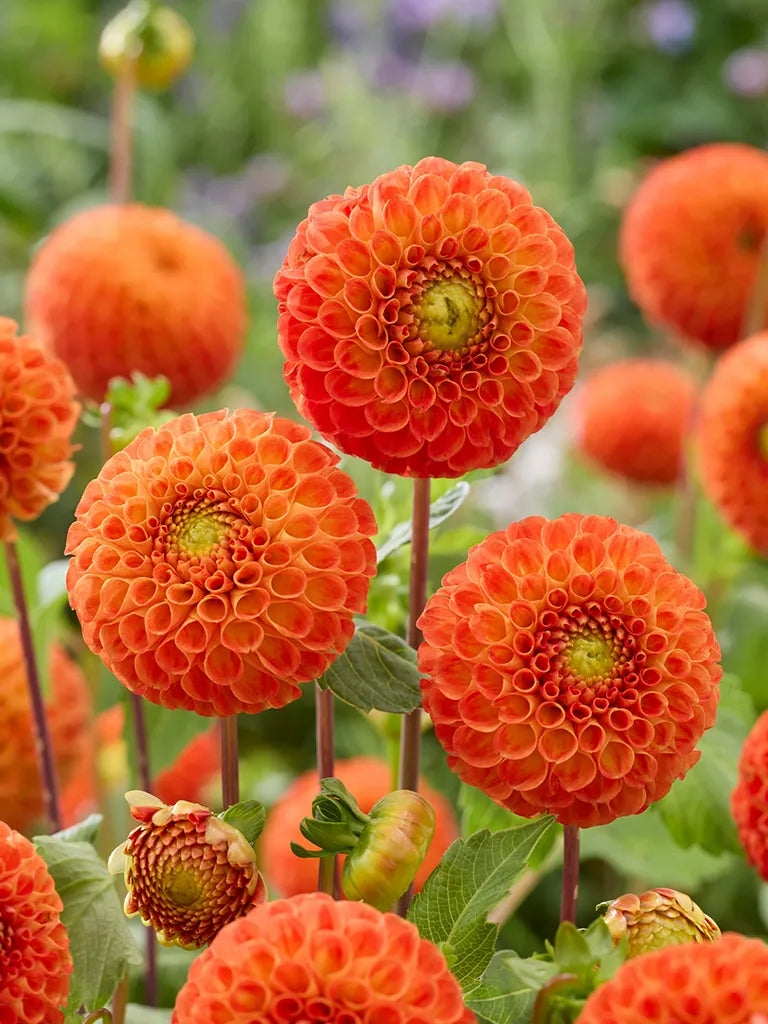
Orange Pompon Dahlia ‘Bantling’
The Dahlia ‘Bantling’ is a pompon dahlia with perfectly round, ball-shaped flowers in a warm orange shade. Pompon dahlias have smaller flowers (around 7 cm in diameter) than ball dahlias such as ‘Sylvia’, but they bloom more abundantly.
The plant has green foliage and grows to approximately 90 cm tall. The flower stems are red, making ‘Bantling’ very suitable as a cut flower.
The flowering period lasts from July until the first frost. Removing spent flowers encourages continuous blooming.
Planting Instructions for Dahlia ‘Bantling’
Starting Indoors
Dahlias are not frost-hardy. From March onwards, the tubers can be started indoors to give them a head start. After the risk of frost has passed (around mid-May), the plants can be moved outside. If planted earlier, protect them from night frost.
Planting Outdoors
If planting directly outdoors, wait until after the last frost, usually around mid-May. The tubers can then be planted safely and will flower after approximately 60–90 days.
Plant the tuber with the old stem facing upwards, about 2–3 cm below the soil surface. Keep a spacing of about 50 cm between plants.
Planting is possible until the end of June.
Location
Dahlias prefer a sunny location with nutrient-rich, well-drained soil, ideally slightly calcareous.
The Dahlia ‘Bantling’ grows to about 90 cm tall and generally does not require staking.
For container planting, use a pot with a minimum diameter of 40 cm to prevent the soil from drying out too quickly.
Pinching Dahlias
Pinching encourages bushier growth and more abundant flowering. Dahlias should be pinched once they have developed at least 2 to 4 pairs of leaves.
Using clean, sharp scissors, cut the stem just above a leaf node. Any flower buds below the cut can be removed to allow the plant to focus its energy on producing side shoots.
Care of Dahlia ‘Bantling’
Keep the soil consistently moist, as drought can negatively affect growth and flowering.
Remove spent blooms regularly. The dahlia will flower until the first frost. After flowering, cut the plant back to ground level. Tubers left in the ground should be protected with leaves during winter or lifted and stored frost-free in colder climates.
Feed the plant several times during the growing season, as dahlias are heavy feeders.
Propagation
In autumn, the tubers continue to develop. The best time to lift them is just before the first frost. They can be divided immediately or in spring. Dividing in spring makes it easier to identify growth points.
Edible
All parts of the Dahlia ‘Bantling’ are edible. The tuber has a mild, carrot-like flavor, and the flowers can be used to decorate salads or flavor water.
Origin
Dahlias originate from Mexico, where they were originally cultivated as a food crop. Once their ornamental value was recognized, they became one of the most diverse and popular ornamental plant groups worldwide.
Bio Dahlia 'Bantling' ordering information
✅ Skal certified: 109459
📦 Individually packed or choose a stacking discount.
💰 Stacking discount: B
Characteristics
| Flowering period: | July - October |
| Planting time: | From May (or from March indoors) |
| Planting depth: | 2 cm below ground |
| Planting distance: | 50 cm apart |
| Height: | 90 cm high |
| Flower diameter: | 7 cm wide |
| Location: | Sunny to partial shade |
| Soil pH: | Loam, sandy soil - slightly acidic/neutral |
| Winter hardiness: | Not winter hardy |
| Propagation: | Good |
| Origin: | Mexico |
| Family: | Asteraceae (composite family) |
| Colour: | Orange |
| Group: | Pompom |
| Bee-friendly: | No |
| Fragrant: | No |
| Tuber size: | 1st size |
Other dahlia varieties

NL-BIO-01