Bloemoloog
Estimated Shipping Widget will be displayed here!
Couldn't load pickup availability
Order now, delivery in 7 to 14 working days.
Organic star-of-Bethlehem bulb mix
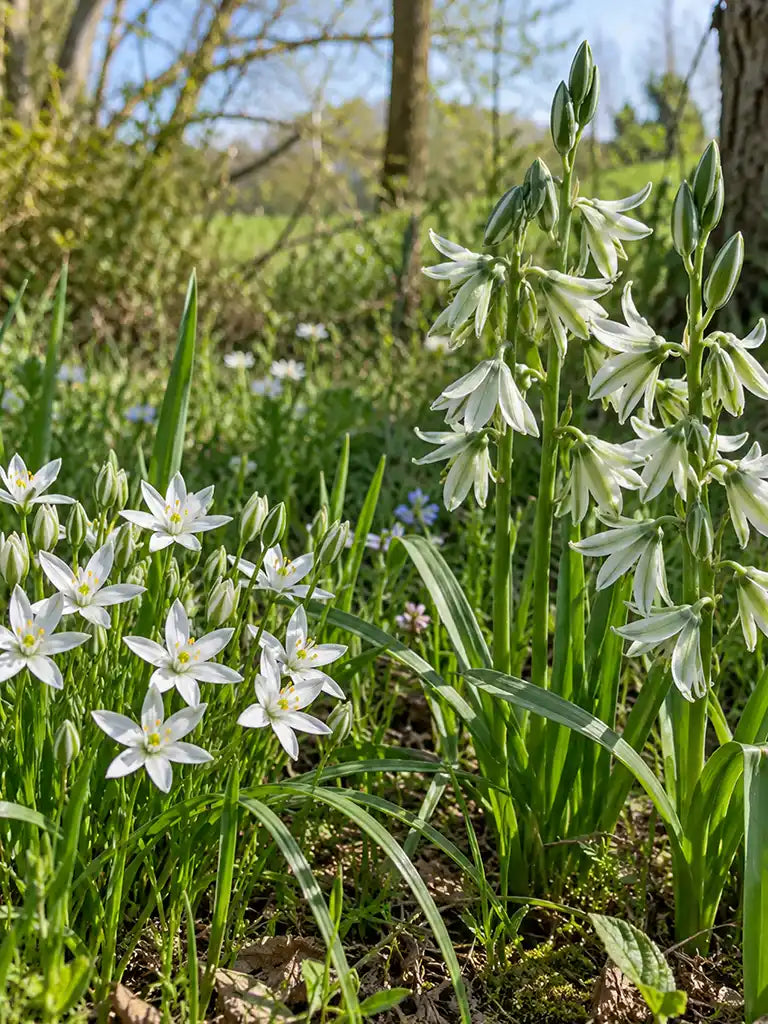
This pack contains 10 organic bulbs of two species: Ornithogalum umbellatum, common star-of-Bethlehem, and Ornithogalum nutans, nodding star-of-Bethlehem. At first glance, they look alike, but the difference becomes clear once they flower. Common star-of-Bethlehem produces white, star-shaped flowers that open in sunny weather. The flowers of nodding star-of-Bethlehem hang slightly downwards. They are a little larger and have silvery-green markings.
Common star-of-Bethlehem stays fairly low, usually around 15 to 25 cm. Its flowers form loose umbels above narrow foliage and close again when the sun disappears. Nodding star-of-Bethlehem grows a little taller, around 20 to 40 cm. Its flowers hang in a raceme along the stem and have a broad green stripe on the outside. Both species flower in April and May, sometimes continuing a little longer.
These bulbs suit places where plants can grow a little more freely: a border under a tree, a small lawn or a space among perennials that emerge later in spring. The bulbs can stay in the ground for many years and spread naturally in a suitable spot.
What is the difference between common and nodding star-of-Bethlehem?
The clearest difference is in the flowers. Those of Ornithogalum umbellatum face upwards and open fully in sunlight, looking like little white stars from above. A green stripe runs along the back of each petal. Ornithogalum nutans flowers differently. Its blooms hang downwards and are slightly more bell-shaped. Their colour is also a little different: white with a silvery-green sheen. The contrast is especially clear when the two species grow side by side.
How, where and when should you plant the star-of-Bethlehem mix?
Plant the bulbs in autumn, from September to December. Make a planting hole around 6 to 10 cm deep and leave about 8 to 10 cm between the bulbs. You can plant them in neat groups, but a looser scattering often gives a more natural result. In spring, the leaves appear first, followed by the flower stems.
A spot in sun or partial shade is suitable. They often grow well beneath deciduous trees, as enough light still reaches the soil in spring. The ground can remain slightly moist during growth but must drain well. Both species suit humus-rich sandy soil or loam. Neutral to slightly lime-rich soil is suitable.
Care
These bulbs need little work. After flowering, leave the foliage until it turns yellow naturally. The bulb draws nutrients from it for the following year. Only remove the leaves once they have died back completely. Leave spent flowers if you want the plants to set seed.
There is no need to lift the bulbs in summer. In a suitable spot, they return each spring and gradually produce new offsets. Common star-of-Bethlehem in particular can spread strongly. If a clump becomes too large, lift and separate the bulbs after the foliage dies back, then replant them in autumn. A little organic feed in spring can help, but it is often unnecessary in ordinary garden soil.
Origin
Common star-of-Bethlehem, Ornithogalum umbellatum, grows naturally in parts of Europe and also occurs in the wild in the Netherlands. It can be found in grassland, along verges and in places where enough light reaches the ground in spring.
Nodding star-of-Bethlehem, Ornithogalum nutans, originates from southeastern Europe and western Asia. It was widely planted on country estates and in old gardens, where it has persisted and spread in various places. It is therefore also classed as a stinzen plant, one of the traditional naturalising plants of historic Dutch gardens. Both species suit gardens where planting does not have to be strictly formal.
Organic star-of-Bethlehem mix ordering information
✅ Skal certified: 109459
📦 Packed in sets of 10 organic bulbs. The pack contains a mix of Ornithogalum umbellatum and Ornithogalum nutans. The proportion of each species may vary between packs.
💰 Quantity discount: D
Characteristics
| Flowering period: | April – May |
| Planting time: | From September |
| Planting depth: | 6–10 cm deep |
| Plant spacing: | 8–10 cm apart |
| Height: | 15–40 cm |
| Flower diameter: | 2–4 cm |
| Position: | Partial shade, sun |
| Soil / pH: | Humus-rich sandy soil or loam – neutral to slightly alkaline |
| Hardiness: | Hardy |
| Propagation: | Good (naturalises) |
| Family: | Asparagaceae (asparagus family) |
| Colour: | White, silvery green |
| Bee-friendly: | Yes |
| Fragrant: | Barely noticeable |
| Bulb size: |
8+ |

NL-BIO-01