Bloemoloog
Estimated Shipping Widget will be displayed here!
Couldn't load pickup availability
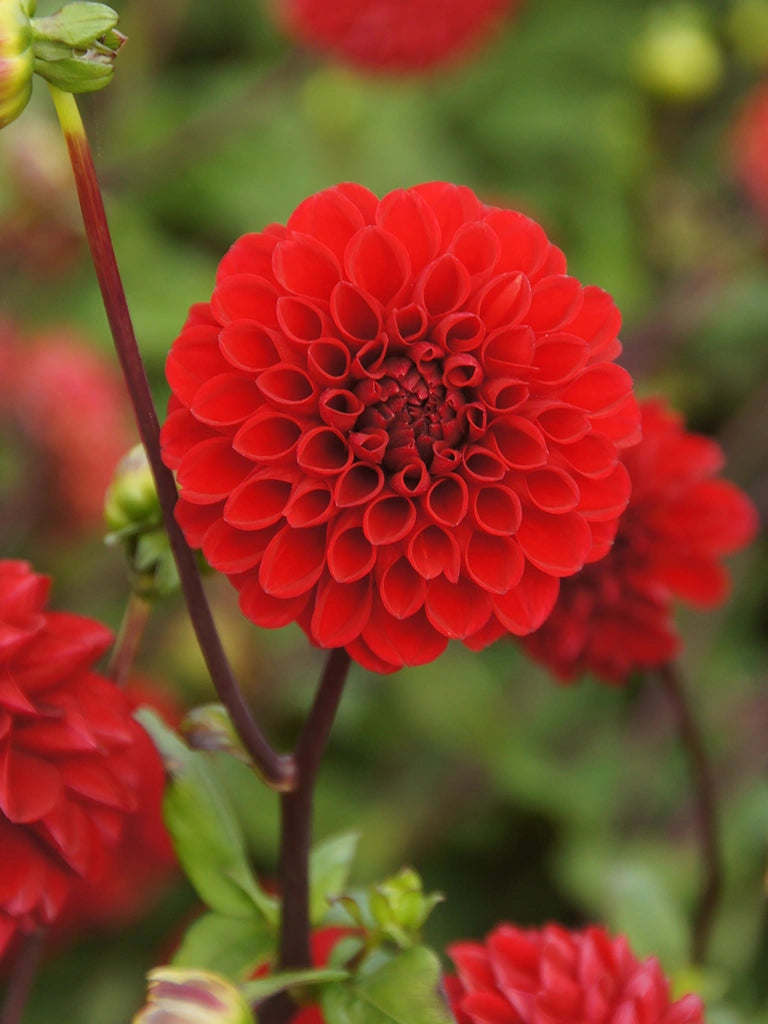
Organic red ball dahlia
The Dahlia 'Viking' produces medium-sized red flowers with a diameter of approximately 10 centimeters. The blooms are formed by many tightly rolled petals that together create a perfectly round ball shape. What makes these spherical flowers special is that the golden ratio is clearly visible in the flower structure. It has green foliage and flower stems reaching about one meter in height, making it very suitable as a cut flower.
Dahlias bloom for an exceptionally long period, up to 100 days per year, as long as spent flowers are removed regularly. A true sea of flowers, especially late in the season when most other plants have already finished blooming.
How, where and when should I plant organic dahlia tubers?
Starting indoors
The Dahlia 'Viking' is not winter-hardy. From March onwards, the tubers can be started indoors. This gives the plant a head start in growth and results in earlier flowering. After the last frost (around 15 May), the young plants can be moved outdoors. In good weather this may be earlier, but beware of night frost.
Planting outdoors
If you choose to wait until after frost to plant the dahlia tubers, this can be done up to 15 May. From then on, the tubers can safely be planted outdoors and will start flowering approximately 60 to 90 days later. Plant the tuber with the old flower stem from the previous year facing upwards, about 2 to 3 centimeters below the soil surface, and keep a spacing of around 50 centimeters between tubers.
The planting season runs until the end of June.
Location
Dahlias prefer a sunny position in nutrient-rich, well-draining soil, ideally a lime-rich sandy soil.
The Dahlia 'Viking' grows to about one meter tall and has medium-sized flowers. Support is generally not required, although planting in a sheltered location is recommended.
For container planting, choose a pot with a minimum diameter of 40 centimeters to prevent the soil from drying out too quickly during summer.
Pinching dahlias
Pinching a dahlia is a technique used to stimulate growth and create a more compact and fuller plant. Dahlias are pinched when they have reached a certain height and are in an active growth phase. We recommend allowing at least 2 to 4 pairs of leaves to develop before pinching.
A leaf node is the point where a leaf attaches to the stem. Look for the upper leaf pairs and use sharp, clean pruning shears to cut the stem just above a leaf node. If flower buds are present below the cut, they can also be removed. This helps the plant direct more energy into developing side shoots, resulting in a more floriferous plant.
Care
Keep the soil around the Dahlia 'Viking' consistently moist. Soil that is too dry can cause problems with growth and flowering.
During the flowering period, remove spent blooms regularly to encourage continuous flowering. Dahlias bloom until the first night frost. After frost, cut the plant back to ground level. Tubers planted in the ground should be protected with leaves during winter against light frost. In severe frost, they should be stored frost-free in a dry place. Lifting the tubers has the advantage that they can be divided each year.
Feed the plant several times per year for optimal results. Dahlias are fast-growing plants with high nutrient requirements.
Giving back to nature
In autumn, the remains of the dead plant can be cut back and worked into the soil as organic matter. This returns nutrients to the soil and keeps your green waste bin free for kitchen waste.
Propagation
In autumn, the tubers continue to grow and develop well. Do not lift the tubers too early for propagation; the best time is just before the first frost. The tubers can be divided immediately or in spring. The advantage of dividing in spring is that the growth points are already visible, making it easier to determine where to split the tuber.
Edible
All parts of the Dahlia 'Viking' are edible. The tuber has a carrot-like flavor, and the flower can be used to garnish salads or to decorate and flavor water in a carafe.
Origin
Dahlias originate from Mexico and have been grown in European gardens since 1615. Originally, they were cultivated as edible tubers, but after their ornamental value was discovered, they became one of the most diverse plant genera in the world, with a vast number of cultivars.
Bio Dahlia 'Viking' ordering information
✅ Skal certified: 109459
📦 Packed per piece or available with bulk discount.
🛒 Available to order from January 2027. Subscribe to our newsletter to receive a notification.
💰 Bulk discount: B
Characteristics
| Flowering period: | July – October |
| Planting time: | From May (or start indoors from March) |
| Planting depth: | 2 cm below soil level |
| Plant spacing: | 50 cm apart |
| Height: | 100 cm |
| Flower diameter: | 10 cm |
| Position: | Partial shade, full sun |
| Soil pH: | Loam, sandy soil – slightly acidic / neutral |
| Hardiness: | Not winter-hardy |
| Propagation: | Good |
| Origin: | Mexico |
| Family: | Asteraceae (daisy family) |
| Color: | Red |
| Group: | Ball dahlia |
| Bee-friendly: | No |
| Fragrant: | No |
| Tuber size: | 1st grade |
Other dahlia varieties

NL-BIO-01