Bloemoloog
Estimated Shipping Widget will be displayed here!
Couldn't load pickup availability
Unfortunately sold out – Subscribe to our newsletter for updates on stock availability.
Organic pink woodland sage
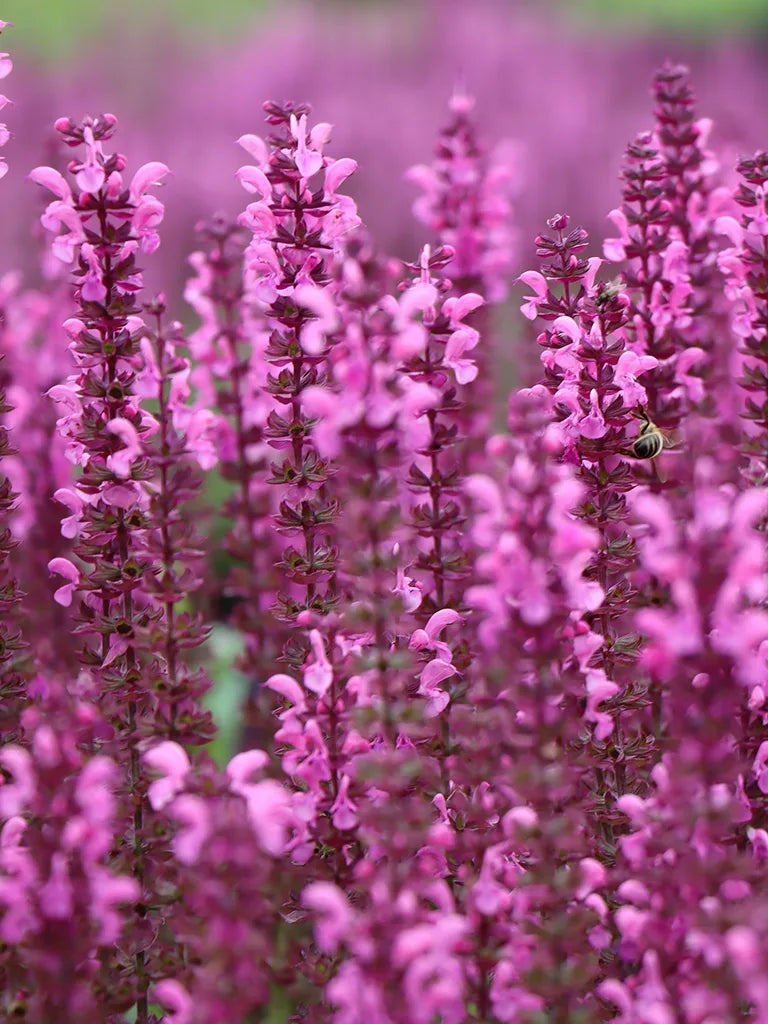
The pink Salvia × superba 'Rose Queen', also known as woodland sage, is a strong perennial that immediately stands out with its upright flower spikes reaching about 60 centimetres in height. It adds height and lightness to the border without becoming heavy. The many small, closely packed lip-shaped flowers glow in a warm rose-red colour, creating a full and vibrant display.
The fresh green foliage is elongated and lightly hairy, giving the plant a soft appearance. Rub a leaf between your fingers and the familiar aromatic scent of sage is released.
'Rose Queen' flowers from June through August. If you cut back the spent flower stems after the first bloom, you are often rewarded with a second flowering later in summer, provided the weather is favourable.
Salvia × superba 'Rose Queen' is also highly attractive to bees and bumblebees, which readily visit the flowers.
How, where and when to plant woodland sage
Salvia is a perennial plant that can be planted year-round. The rhizomes can be planted immediately upon arrival. Plant the roots deep enough so that the young green leaves are just above the soil surface.
Plant it in a sunny location in well-drained soil. Sandy or loamy soils are ideal, as excess water drains away quickly and keeps the roots healthy. Heavy clay soils can be too wet; improve them with compost if necessary to enhance structure and drainage.
Plant Salvia × superba 'Rose Queen' in the middle of the border or in pots. It combines beautifully with white salvias such as Salvia nemorosa 'Schneehügel' or with the slightly lower Oxalis deppei 'Iron Cross'.
Care
Provide sufficient water, especially during dry periods. A layer of mulch around the plant helps retain moisture and keep the soil cool.
After the first flowering in summer, the spent flower stems are cut back to encourage a second bloom. In spring, dead or damaged parts can be removed to promote new growth.
Apply a balanced (organic) fertiliser annually for best results.
Propagation
After about 5 years, the rhizomes can be divided (this can also be done earlier, but we recommend about every 5 years). Split or cut the root into smaller sections and replant them. This rejuvenates the plant and keeps it vigorous.
Sage as an ornamental plant
This sage is grown as an ornamental plant for gardens and containers. The sage commonly used in cooking is a different species: Salvia officinalis. White sage used as incense, Salvia apiana, is also a different species; white flowers do not make 'Schneehügel' an incense sage. We therefore offer this sage as an ornamental plant, rather than a culinary herb or a plant for herbal tea.
Bio Salvia × superba 'Rose Queen' ordering information
✅ Skal certified: 109459
📦 Packed per piece or choose volume discount!
💰 Volume discount: B
❗ Please note: you are purchasing the rhizomes!
Characteristics
| Flowering period: | June – August |
| Planting time: | Year-round |
| Planting depth: | Green above soil level |
| Plant spacing: | 7 per m² |
| Height: | 60 – 70 cm |
| Flower diameter: | 5 cm |
| Position: | Partial shade, sun |
| Soil pH: | Loamy or sandy soil – slightly alkaline / neutral |
| Hardiness: | Extremely hardy |
| Propagation: | Good |
| Origin: | Central Asia |
| Family: | Lamiaceae (mint family) |
| Colour: | Pink |
| Bee-friendly: | Yes |
| Fragrant: | Yes |
| Quality: | Undivided |
Other sage

NL-BIO-01